Evaluating Baby Girl Cloths Watercolor Clipart for Your Creative Projects
In the realm of digital crafting and small business design, selecting the right visual assets is a critical decision that impacts the final quality of your products. When working on projects centered around infants and young children, Baby Girl Cloths Watercolor Clipart offers a specific aesthetic that blends softness with artistic depth. Unlike standard vector illustrations or flat graphics, watercolor textures introduce an organic, hand-painted feel that resonates well with parents and gift buyers. However, before integrating these files into your workflow, it is essential to understand their technical specifications, compare them against alternative formats, and evaluate whether they align with your specific production methods.
Understanding the Distinctive Qualities of Watercolor Textures
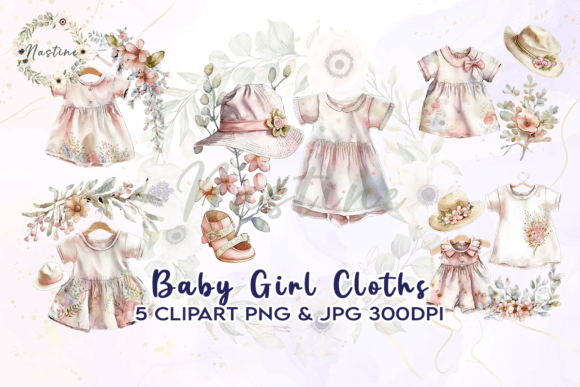
The primary appeal of Baby Girl Cloths Watercolor Clipart lies in its texture. Watercolor art mimics the flow of pigment on paper, creating soft edges, subtle color gradients, and a sense of movement that rigid lines cannot replicate. For designs involving baby clothing, this style evokes tenderness and warmth, making it particularly suitable for nursery decor, personalized gifts, and apparel for newborns.
These digital files are typically provided as high-resolution raster images, specifically at 4000x4000 pixels with a resolution of 300 DPI. This specification is crucial because it ensures that when printed, the image retains clarity without appearing pixelated or blurry. The use of a transparent background further enhances versatility, allowing designers to overlay these cloths onto various surfaces—from white ceramic mugs to dark-colored t-shirts—without unsightly borders. The absence of watermarks in the final download ensures that the product looks professional and ready for commercial use immediately upon acquisition.
Comparing Formats: Raster Watercolor vs. Vector Illustrations
When evaluating digital assets, the choice between raster-based watercolor clipart and vector graphics often dictates the scope of your project. Vector files, such as SVGs or EPS, are mathematically defined and can be scaled infinitely without losing quality. They are ideal for vinyl cutting machines like Cricut or Silhouette, where precise paths are required to cut shapes out of material.
In contrast, Baby Girl Cloths Watercolor Clipart exists as a raster image (PNG or JPG). While it cannot be resized indefinitely without potential degradation, its strength lies in the complexity of its shading and texture. Vectors generally struggle to mimic the random, fluid nature of watercolor unless created with immense effort. If your goal is to achieve a realistic, painted look for sublimation printing or digital scrapbooking, the raster format of this clipart is superior. However, if you intend to cut the shape out of vinyl using a die-cut machine, you may find the soft, feathered edges of watercolor difficult to work with compared to the hard lines of a vector graphic.
Color Mode Considerations: RGB vs. CMYK
A significant technical factor to consider is the color mode. These digital files are created in RGB Color Mode. RGB (Red, Green, Blue) is the standard for screens and digital displays, offering a vibrant spectrum of colors. It is also the native mode for most modern inkjet printers used in home and small-business settings, particularly those designed for sublimation.
If you are planning to print these designs for physical products, ensuring your software is set to match the file's specifications is vital. To maintain color accuracy, your design software should be configured to RGB with a DPI setting of 300. Mismatching these settings—for instance, forcing an RGB file into a CMYK workflow without proper conversion—can result in duller, less vibrant prints. It is important to note that colors will vary depending on individual monitor settings. What appears bright pink on one screen might appear slightly different on another, so relying solely on your monitor for color matching can be risky. Always test print a sample before committing to a large batch of products.
Best Use Cases for High-Resolution Digital Downloads
The versatility of Baby Girl Cloths Watercolor Clipart extends across a wide range of applications, but some uses yield better results than others. The high resolution (300 DPI) makes these files particularly well-suited for direct-to-garment (DTG) printing and sublimation. Sublimation, which involves transferring dye into the substrate using heat and pressure, thrives on detailed, full-color images. The soft gradients of the watercolor style transfer beautifully onto polyester fabrics, tumblers, and coated mugs, creating a seamless, professional finish.
For crafters engaging in card making, scrapbooking, and journaling, these files offer a quick way to add artistic flair without needing painting skills. Because the background is transparent, the cloths can be easily integrated into digital planners or layered over photos in invitations. The lack of watermarks ensures that the final output looks polished, whether it is viewed on a tablet or printed on heavy cardstock.
Wall art and coasters are also excellent candidates for this type of clipart. The 4000x4000 pixel dimension allows for large-format printing while maintaining sharpness. A single cloth design can be enlarged to poster size for a nursery wall, or repeated in a pattern for a set of decorative coasters. The organic nature of the watercolor style adds a touch of sophistication that distinguishes handmade goods from mass-produced items.
Limitations and Tradeoffs to Consider
While Baby Girl Cloths Watercolor Clipart offers distinct advantages, it is not a universal solution for every crafting need. One limitation is the requirement for specific hardware if you plan to utilize sublimation. To fully leverage these files for sublimation, you must have access to a dedicated sublimation printer and a heat press. Standard inkjet printers using regular dye or pigment inks will not produce the same permanent, vibrant results on non-paper substrates. Without the correct equipment, the investment in high-quality digital files may not translate into the desired physical product.
Additionally, the soft edges inherent to watercolor styles can pose challenges for certain types of vinyl decal work. If you are using a weeding tool to remove excess vinyl, the fuzzy boundaries of a watercolor image can make the process tedious and prone to error. In scenarios requiring crisp, clean cuts for iron-on transfers or stickers, a solid-color vector illustration might be a more practical choice. It is important to weigh the aesthetic desire for a painted look against the mechanical limitations of your production tools.
Decision Factors: Is This the Right Resource for You?
Determining whether Baby Girl Cloths Watercolor Clipart is the right fit depends largely on your end goal and technical setup. If you are a sublimation artist looking to create premium baby-themed merchandise like onesies, bibs, or tumblers, these files are an excellent resource. The combination of high resolution, transparent backgrounds, and vibrant RGB colors aligns perfectly with the demands of sublimation printing.
Conversely, if your primary focus is on vinyl cutting for simple decals or if you require scalable graphics for signage that needs to be blown up significantly beyond 4000 pixels, you might find these raster files limiting. In such cases, exploring vector alternatives or hiring an illustrator to create custom scalable artwork could be a better long-term strategy.
Ultimately, the value of these digital downloads lies in their ability to bridge the gap between professional artistry and accessible DIY crafting. By understanding the technical requirements—such as maintaining 300 DPI and RGB color modes—and recognizing the stylistic strengths of watercolor textures, you can make an informed decision. Whether you are designing a personalized invitation, creating a line of baby apparel, or simply enhancing a personal scrapbook, choosing the right asset ensures that your creative vision is realized with clarity and impact.